
Single-component polyurethane membrane · FLEXCOAT-PU
ResinTech FLEXCOAT-PU Flexible Polyurethane Base Membrane
A single-component, moisture-curing elastomeric polyurethane membrane used as the flexible, crack-bridging, waterproofing base layer beneath ResinTech coating and traffic systems.
- Packaging20 kg pail (single component)
- Mix ratioReady to use — stir until uniform; no Part A / Part B mixing
- FinishNormally covered by HPP, CRU, broadcast coat, tile, screed, protection board or wearing course
- Use environmentProtected interior / exterior assemblies. Topcoat or wearing course required for UV and traffic exposure.
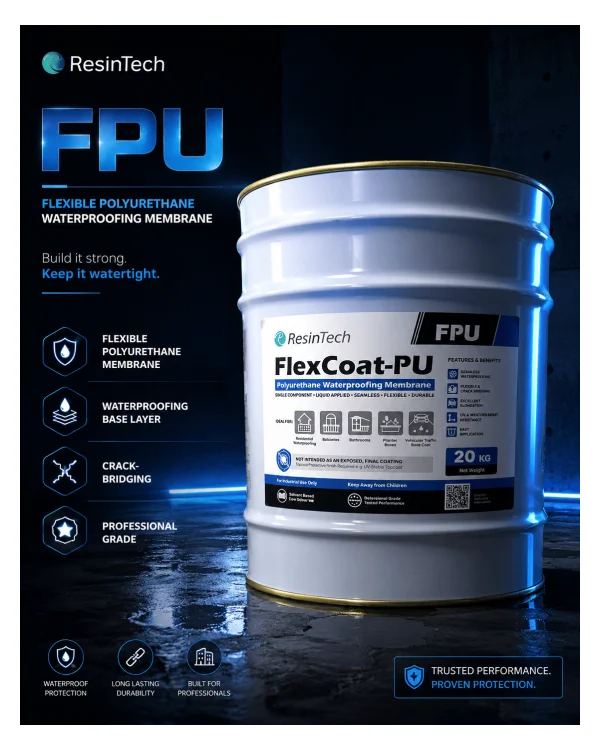
What FLEXCOAT-PU is
FLEXCOAT-PU (product code FPU) is the movement-control layer of the ResinTech line. Applied under the wear surface, it helps protect prepared substrates from normal cracking and water intrusion. It is never the finished surface: the cured membrane must be covered by an approved wearing course — HPP, CRU, an epoxy broadcast layer, tile, screed or protection board — before service.
In the traffic coating system guide it is the “+” modifier: any standard PTS, VTS or EWS build can be specified with a 20–25 mil (standard) or 40–50 mil (enhanced) FPU base for balconies, podiums, rooftop decks, over-occupied spaces and other movement-prone assemblies.
The current data sheet is titled “FPU — Flexible Polyurethane Base Membrane”; the product is sold and labelled as FLEXCOAT-PU.
Packaging
| Component | Size |
|---|---|
| Single component | 20 kg pail |
Mix ratio: Ready to use — stir until uniform; no Part A / Part B mixing
Supported applications
- Balcony, podium, plaza and rooftop deck waterproofing under approved protection systems
- Crack-bridging base membrane below ResinTech traffic coatings where movement accommodation is required
- Parking deck waterproofing below approved aggregate, reinforced or traffic-bearing wearing courses
- Wet-area waterproofing under compatible tile, screed or protection layers
- Detail membrane around drains, corners, wall / floor transitions, pipe penetrations and static cracks
- Strata, parkade, balcony and podium restoration where water control and movement risk matter
- Protected below-grade, foundation, retaining wall and masonry waterproofing after proper preparation
Role in ResinTech systems: Flexible crack-bridging base layer — the “+” modifier in PTS+, VTS-P+, VTS-D+, EWS-F+ and EWS-X+. See the traffic coating systems.
Product data
| Property | Typical value |
|---|---|
| Components | Single component, moisture-curing polyurethane |
| Chemistry | Isocyanate / polyether-polyol polyurethane membrane |
| Solids content | 98 % by weight (ASTM D1353; solvent-free grade) |
| VOC | Low — solvent-free grade (confirm g/L against the current SDS) |
| Application methods | Roller, brush, scraper / squeegee or approved airless spray |
| Shelf life | 12 months, unopened, stored at 5–35 °C |
Performance properties
Typical values at 23 °C and 50 % RH unless noted, as published in TDS-FPU-1.0. Not a guarantee of performance.
| Property | Typical value | Method / note |
|---|---|---|
| Bond strength to concrete | 150 psi | ASTM D4541 — surface preparation and primer control final adhesion |
| Tensile strength | 300 psi | ASTM D412 reporting class |
| Elongation | 800 % | ASTM D412 |
| Tear strength | ≈ 86 lbf/in (15 N/mm) | ASTM D624 reporting class |
| Shore hardness (ASTM D2240) | Not published — TDS-FPU-1.0 and the systems design guide (Rev 1.12) state different values; confirm with ResinTech before specifying | |
| Tack-free time | 8 h | ASTM D1640 typical |
| Drying time | 20 h at 15 mils | ASTM D1640, 24 °C / 50 % RH |
| Watertightness | ≈ 44 psi (0.3 MPa) for 120 min, watertight | EN 1928 reporting class |
| Low-temperature flexibility | −35 °C, no cracking | ASTM D522 reporting class |
| UV stability | Limited | Requires an approved UV-stable topcoat or protection if exposed |
Working time, recoat and cure
| Condition | Requirement |
|---|---|
| Recoat interval | Typically 8–12 h between coats, depending on film build, temperature, humidity and ventilation |
| Maximum wet film per coat | 0.7 mm (≈ 28 mils) — thicker coats increase bubbling, skinning or slow-cure risk |
| Subsequent protection | Allow the membrane to dry before applying topcoat, broadcast, tile, screed or protection layer |
Typical values at 23 °C / 50 % RH.
Coverage and film build
| Use | Film build | Typical coverage |
|---|---|---|
| Traffic crack-bridge base | 20–25 mils | ≈ 300–240 ft² per 20 kg |
| Enhanced movement base | 40–50 mils | ≈ 150–120 ft² per 20 kg |
| Protected waterproofing membrane | 1.0–1.5 mm (≈ 40–60 mils) in 2–3 coats | ≈ 155–105 ft² per 20 kg |
| Theoretical consumption | per 1 mm DFT | ≈ 1.3–1.5 kg/m² (≈ 165–145 ft² per 20 kg at 1 mm, smooth substrate) |
Coverage per 20 kg pail is approximate and assumes a smooth substrate. The TDS notes the kit volume is still to be confirmed — verify actual yield by mock-up or site trial.
Application conditions
| Condition | Requirement |
|---|---|
| Substrate temperature | 5–35 °C during application and cure |
| Ambient condition | Dry, stable; protect from rain, condensation and water before cure |
| Dew point | Substrate at least 3 °C above dew point |
| Substrate | Structurally sound, stable, clean, smooth and dry |
| Concrete strength | 3,600 psi compressive; 220 psi tensile pull-off recommended for coating systems |
| Priming | Prime porous, marginal, moisture-risk or project-specified substrates with a ResinTech-approved primer |
Limitations
- A base membrane — must be covered by a ResinTech-approved traffic or protection system before service. Do not use as the exposed tire-traffic, abrasion or chemical wear surface.
- UV-exposed applications require an approved UV-stable topcoat or protection system.
- Do not bridge expansion joints or active movement joints with field membrane alone; movement joints need a project-specific joint detail.
- Do not exceed 0.7 mm (≈ 28 mils) wet film per coat unless approved by ResinTech.
- Not for potable water, tank, pool, submerged or aggressive chemical service unless the full system is specifically approved.
- Do not apply over damp, frozen, contaminated, incompatible or unprepared substrates.
Technical documents
- ResinTech FLEXCOAT-PU (FPU) — Technical Data SheetTDS · TDS-FPU-1.0 · Rev 1.0 · Single component · 4 pages · PDF
- ResinTech FLEXCOAT-PU — Safety Data Sheet (Canada / WHMIS)SDS · SDS-FPU-1.0 · Issued June 2026 · Single component · 6 pages · PDF
Documents are the current versions published by ResinTech at the time this page was last built. Safety Data Sheets cover both components where the product is two-part.
Related products
Questions and answers
Can FLEXCOAT-PU be left exposed?
No. It is the flexible base layer and has limited UV stability. It must be protected by an approved wearing course — HPP, CRU, an epoxy broadcast layer, tile, screed or protection board — before service.
What thickness is used under a traffic coating?
20–25 mils as the standard crack-bridging base, or 40–50 mils as the enhanced base for balconies over living space, podiums, rooftop decks and other high-movement assemblies.
How is a waterproofing membrane built up?
Typically 1.0–1.5 mm finished thickness in 2–3 coats, with no coat exceeding 0.7 mm wet, and detail reinforcement (extra coat or fabric) at corners, drains, transitions and static cracks first.
What is the difference between FLEXCOAT-PU and PPM?
FLEXCOAT-PU is the flexible crack-bridging base that accommodates movement within a traffic system. PPM is a single-component polyurea-based waterproofing membrane specified where a bonded waterproofing layer is required. Each has its own data sheet; neither is part of the other’s documented build.