
Single-component polyurea-based membrane · PPM
ResinTech PPM Protective Polymer Membrane
A single-component, moisture-cured elastomeric coating that forms a continuous, seamless waterproofing membrane on horizontal, vertical and inclined surfaces.
- Packaging10 L pail (single component)
- Mix ratioReady to use; apply directly from the container
- FinishLiquid-applied membrane
- Use environmentInterior and exterior waterproofing; weather resistance depends on system build and exposure conditions.
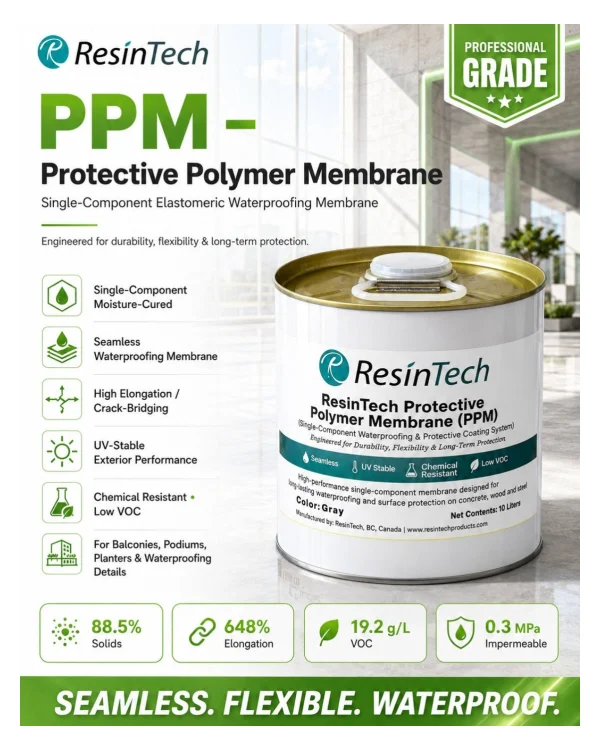
What PPM is
PPM cures by reaction with ambient moisture to a crosslinked elastomeric film. It is applied straight from the pail by brush, roller, trowel or spray — no on-site proportioning — and forms a dense, pinhole-free membrane at the recommended thickness.
The safety data sheet describes it as a polyurea-based waterproofing coating. It is used for parkades, balconies, podiums, foundations, planters, roofs and as an intermediate waterproofing layer within ResinTech coating systems. In roofing it may be used as a stand-alone liquid-applied membrane where mechanical traffic or wear layers are not required.
Packaging
| Component | Size |
|---|---|
| Single component | 10 L pail |
Mix ratio: Ready to use; apply directly from the container
Supported applications
- Parkades, ramps and mechanical rooms
- Balconies, patios, podium slabs and sundecks
- Basements, foundations and retaining walls
- Swimming pool decks, tanks and containment areas
- Planters, roofs and waterproofing details
- Infrastructure and dam-proofing waterproofing applications
- Intermediate waterproofing layer within ResinTech coating systems
Role in ResinTech systems: Project-specific bonded waterproofing layer; not one of the five materials in the traffic coating system guide. See the traffic coating systems.
Product data
| Property | Typical value |
|---|---|
| Components | Single component, moisture-cured |
| Solids content | 88.5 % |
| VOC | 19.2 g/L (tested) |
| Absorption rate | 2.8 % |
| Application methods | Brush, roller, trowel; spray / airless spray |
| Shelf life | 12 months, unopened, stored at 5–30 °C |
Performance properties
Typical values at 23 °C and 50 % RH unless noted, as published in TDS-PPM v1.1. Not a guarantee of performance.
| Property | Typical value | Method / note |
|---|---|---|
| Tensile strength | 2.45 MPa | As reported in TDS-PPM v1.1 |
| Elongation at break | 648 % | As reported in TDS-PPM v1.1 |
| Tear strength | 19 N/mm | As reported in TDS-PPM v1.1 |
| Bond strength to concrete | 1.06 MPa | Exceeds the ≥ 1.0 MPa requirement stated in the TDS |
| Low-temperature flexibility | −35 °C, no cracking | As reported in TDS-PPM v1.1 |
| Heat ageing (80 °C, 168 h) | 95 % tensile retention; 566 % elongation | As reported in TDS-PPM v1.1 |
| Alkali immersion (168 h) | 93 % tensile retention; 564 % elongation | As reported in TDS-PPM v1.1 |
| Acid immersion (168 h) | 94 % tensile retention; 559 % elongation | As reported in TDS-PPM v1.1 |
| Water impermeability | 0.3 MPa × 120 min, impermeable | As reported in TDS-PPM v1.1 |
Working time, recoat and cure
| Condition (≈ 20 °C) | Typical value |
|---|---|
| Drying time | Approximately 9 h |
| Working / action time | 21 h |
| Recoat window | 16–24 h |
| Full cure | 24–48 h |
Curing rate and final film properties are influenced by temperature, humidity, airflow and film thickness.
Coverage and film build
| Use | Film build | Typical coverage |
|---|---|---|
| Waterproofing membrane | 1.2–1.5 mm recommended | ≈ 1.5–1.8 kg/m² at full recommended thickness |
| Per coat | Avoid excessively thick single coats | 80–100 ft² per US gallon per coat |
| Roofing over occupied space | Three stages at ≈ 20–25 mils wet each; minimum total ≈ 60 mils | Per project design |
| Non-occupied roof areas | ≈ 20–25 mils total | Per project design |
Consumption and per-coat coverage depend on application method, film thickness and substrate.
Application conditions
| Condition | Requirement |
|---|---|
| Concrete | Minimum 28-day cure; mechanically profiled (CSP 3) |
| Metal | Abrasive blast cleaning to near-white metal |
| Cracks and joints | Reinforcing fabric recommended where movement is anticipated |
| Priming | ResinTech CBE or TUE primer may be employed for enhanced adhesion |
Limitations
- Do not exceed the recommended thickness in a single application; excessive thickness may cause blistering.
- Reinforcement fabric is recommended at cracks and expansion joints.
- Not intended to function as a vapour barrier or for negative-side hydrostatic pressure without additional design measures.
- Weather resistance depends on system build and exposure conditions.
Technical documents
- ResinTech PPM — Technical Data SheetTDS · TDS-PPM v1.1 · v1.1 (supersedes v1.0) · Single component · 3 pages · PDF
- ResinTech PPM — Safety Data Sheet (WHMIS 2015)SDS · SDS PPM v1.0 · v1.0 · Single component · 5 pages · PDF
Documents are the current versions published by ResinTech at the time this page was last built. Safety Data Sheets cover both components where the product is two-part.
Related products
Questions and answers
Does PPM need to be mixed?
No. It is a single-component, moisture-cured product applied directly from the container.
Can PPM be used as a stand-alone roof membrane?
The TDS allows stand-alone use in roofing where mechanical traffic or wear layers are not required. Over occupied space it is applied as a three-stage membrane to a minimum of about 60 mils total.
What primer is used under PPM?
The TDS states a ResinTech CBE or TUE primer may be employed for enhanced adhesion.