
100% solids epoxy · CBE
ResinTech CBE Core Bond Epoxy
A low-odour, two-component, 100% solids epoxy that wets into prepared concrete to prime, bond and reinforce ResinTech flooring, coating and repair assemblies.
- Packaging15 L kit (4.0 US gal mixed)
- Mix ratio2 : 1 by volume, Part A : Part B
- FinishClear to slightly amber; field-pigmented when approved
- Use environmentInterior concrete; exterior only when protected with a UV-stable topcoat.
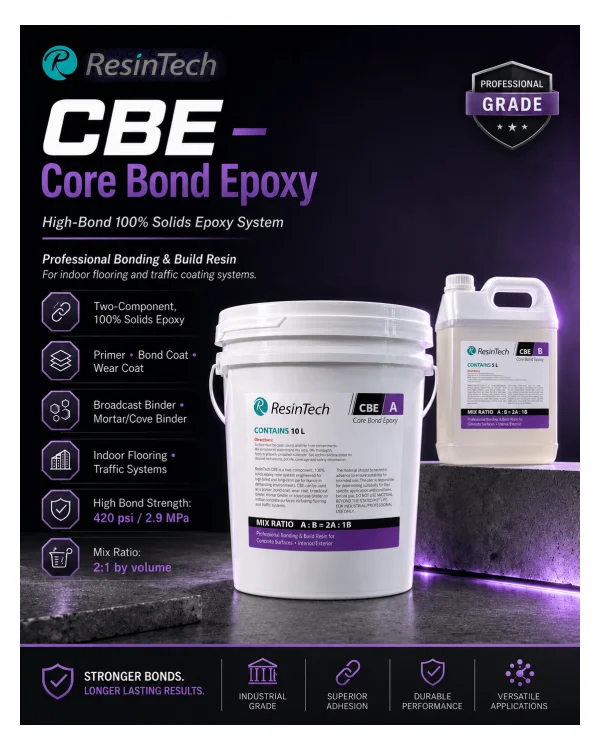
What CBE is
CBE is the standard reinforced epoxy in ResinTech traffic coating systems. On the TDS it carries the highest bond strength to concrete in the range (420 psi, ASTM D4541), which is why it is the preferred epoxy when adhesion, concrete consolidation and reinforced broadcast build matter more than UV stability or flexibility.
One resin covers five jobs: primer, bond coat, wear coat, broadcast binder and epoxy mortar / cove binder. It mixes 2 : 1 by volume with no induction time.
CBE is not UV-stable as an exposed coating. For UV-exposed service it is topcoated with HPP or CRU, or TUE is specified where a UV-resistant epoxy is needed.
Packaging
| Component | Size |
|---|---|
| Part A (resin) | 10 L (2.6 US gal) |
| Part B (hardener) | 5 L (1.3 US gal) |
Mix ratio: 2 : 1 by volume, Part A : Part B
Supported applications
- Concrete primer under epoxy, polyaspartic and urethane systems
- Bond coat for overlays, toppings, patch repairs and cove bases
- Interior wear coat where UV exposure is limited
- Broadcast receiver for silica sand, quartz and decorative flake systems
- Epoxy mortar binder for patching, ramps, coves and floor detailing
- High-bond base resin for parkade, warehouse and service-area assemblies
- Primer for maintenance recoats after preparation and compatibility testing
Role in ResinTech systems: Standard reinforcement layer, broadcast binder and structural wear component in PTS, VTS and EWS systems; also the indoor surface coat option in PTS and VTS-P. See the traffic coating systems.
Product data
| Property | Typical value |
|---|---|
| Components | Two — Part A resin + Part B hardener |
| Mix ratio | 2 : 1 by volume |
| Solids content | 100 % by weight (ASTM D1353) |
| VOC | < 50 g/L |
| Appearance | Clear to slightly amber; may be pigmented where approved |
| Density, mixed | 9.2–9.6 lb/US gal (ASTM D1475) |
| Odour | Low |
| Induction time | None |
| Shelf life | 12 months, unopened, stored at 5–30 °C |
Performance properties
Typical values at 23 °C and 50 % RH unless noted, as published in TDS-CBE-1.0. Not a guarantee of performance.
| Property | Typical value | Method / note |
|---|---|---|
| Bond strength to concrete | 420 psi | ASTM D4541 — typically concrete cohesive failure |
| Tensile strength | 5,100 psi | ASTM D412 / D638 reporting class |
| Elongation | 8 % | Rigid epoxy; not a crack-bridging membrane |
| Abrasion resistance | 50 mg loss | ASTM D4060, CS-17 wheel, 1000 g, 1000 cycles |
| Shore hardness | 80 D | ASTM D2240 |
| Tack-free time | 6 h | ASTM D1640 at 15 mils |
| Drying time | 8 h at 15 mils | ASTM D1640, 24 °C / 50 % RH |
| Water absorption | ≤ 0.3 % | ASTM D570 |
| UV stability | Limited | Topcoat with HPP or CRU for UV exposure |
Working time, recoat and cure
| Temperature | Pot life | Minimum recoat | Maximum recoat | Foot traffic | Full cure |
|---|---|---|---|---|---|
| 10 °C | 50–60 min | 18–24 h | 36–48 h | 48–72 h | ~10 days |
| 20 °C | 35–40 min | 10–18 h | 24 h | ~24 h | ~7 days |
| 30 °C | 15–20 min | 6–10 h | 24 h | 12–18 h | 4–5 days |
If the maximum recoat window is exceeded, abrade to remove gloss, vacuum thoroughly and clean before recoating. Cold slabs slow cure; hot conditions shorten pot life.
Coverage and film build
| Use | Film build | Typical coverage |
|---|---|---|
| Primer / base coat | 6–10 mils | 240–160 ft²/US gal |
| Wear coat | 10–20 mils | 160–80 ft²/US gal |
| Broadcast receiver | 10–20 mils before broadcast | Withheld — see note |
| Bond coat | Thin continuous film | 405–245 ft²/US gal |
| Mortar / cove binder | Filled with clean, dry aggregate | Varies with aggregate ratio and detail size |
Coverage figures under confirmation. Typical coverage for the broadcast-receiver row is withheld while the figure published in TDS-CBE-1.0 is confirmed with ResinTech: it does not reconcile with the 10–20 mil film-build range shown. The film-build range is unchanged. Confirm yield by mock-up.
Theoretical values per US gallon at 23 °C / 50 % RH. A 15 L kit is approximately 4.0 US gal.
Application conditions
| Condition | Requirement |
|---|---|
| Substrate temperature | 10–30 °C |
| Ambient temperature | 10–32 °C |
| Relative humidity | Maximum 85 % recommended |
| Dew point | Substrate at least 3 °C above dew point |
| Concrete moisture | Dry concrete; typical screening limit 4 % Tramex or 85 % RH by ASTM F2170 |
| Concrete age | Normally 28 days unless the designer approves earlier work |
| Minimum concrete strength | 3,600 psi compressive; 220 psi tensile pull-off |
Limitations
- Not UV-stable as a final exposed exterior coating; yellowing or chalking may occur. Use an HPP or CRU topcoat, or specify TUE where a UV-resistant epoxy is needed.
- Not flexible; not intended to bridge dynamic cracks, moving joints or structural movement.
- Not a stand-alone waterproofing membrane or moisture-vapour mitigation system.
- Do not apply to wet, frozen, contaminated or dusty substrates.
- Avoid thick unfilled pours or puddles — exotherm and cure inconsistency.
- Colour and gloss vary with film thickness, temperature, substrate absorption and pigmenting method.
Technical documents
Technical data sheet under revision. TDS-CBE-1.0 is temporarily withheld from download (2026-09-21) while its coverage table is confirmed with ResinTech — the published ft²/US gal figures do not reconcile with the stated film builds (source register C-COV-1). The original PDF is preserved unedited; a revised sheet is pending. Request the current sheet.
- ResinTech CBE — Safety Data Sheet (Canada / WHMIS)SDS · SDS CBE v1.0 · Version 1.0, rev. 2026-07-01 · Part A / Part B · 8 pages · PDF
Documents are the current versions published by ResinTech at the time this page was last built. Safety Data Sheets cover both components where the product is two-part.
Related products
Questions and answers
When is CBE used instead of TUE?
CBE is the standard, high-bond epoxy for priming, bonding and reinforced broadcast layers. TUE is the premium option where a clearer, more UV-resistant epoxy or decorative build is wanted. In ResinTech traffic systems either can serve as the reinforcement layer.
Can CBE be the finished surface?
Indoors or in protected, low-UV conditions, yes — the design guide lists CBE as the indoor surface-coat option in PTS and VTS-P. Outdoors it must be topcoated with HPP or CRU.
Can CBE be used to make an epoxy mortar?
Yes. Mix Part A and Part B fully first, then add clean, dry aggregate to the selected consistency for patching, coves and ramps.