
Aliphatic polyaspartic · HPP
ResinTech HPP High-Performance Polyaspartic
A fast-curing, UV-stable aliphatic polyaspartic used as the exposed surface layer of ResinTech traffic and resin flooring assemblies — clear or pigmented, indoors or out.
- Packaging10 L kit (2.6 US gal mixed)
- Mix ratio1 : 1 by weight, Part A : Part B
- FinishClear or field-pigmented; light, medium or heavy broadcast texture
- Use environmentInterior and exterior concrete coating and traffic coating work.
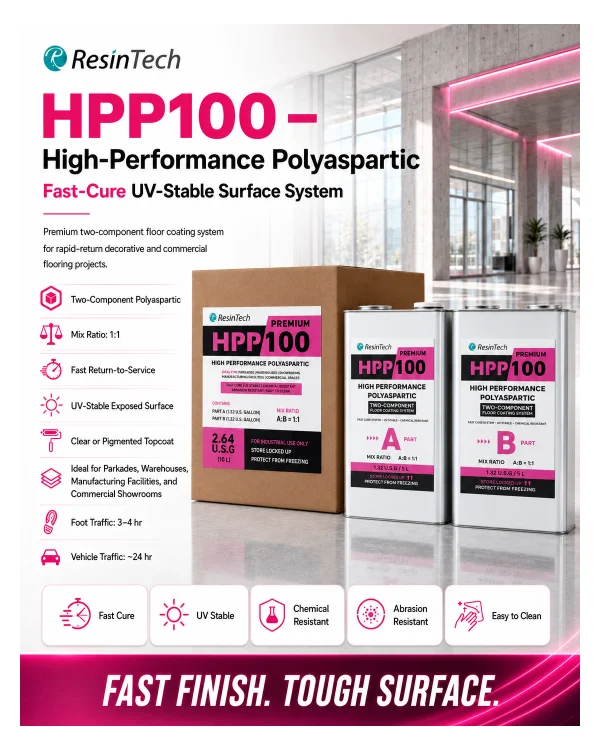
What HPP is
HPP is the core traffic-surface chemistry in the ResinTech range. It is the primary surface coat in the PTS and VTS systems and the functional topcoat in the reinforced EWS systems.
It combines UV stability, fast return to service (light foot traffic in 3–4 hours, vehicles in about 24 hours on the TDS), chemical resistance and traffic-ready durability in one product. It can be applied as a stand-alone topcoat on prepared concrete or as the final wear layer over ResinTech epoxy, broadcast and decorative systems.
Where the priority is maximum long-term abrasion or chemical protection rather than speed, CRU is the premium finish coat applied over it.
Packaging
| Component | Size |
|---|---|
| Part A (resin) | 5 L (1.3 US gal) |
| Part B (hardener) | 5 L (1.3 US gal) |
Mix ratio: 1 : 1 by weight, Part A : Part B
Supported applications
- Parking decks, drive aisles, parking stalls and light-to-moderate vehicular traffic zones
- Balconies, podium decks, exterior walkways, corridors and service areas
- Fast-track commercial, institutional, garage and light industrial flooring
- Clear or pigmented seal coat over decorative flake, quartz, sand or metallic epoxy floors
- UV-stable exposed topcoat over compatible ResinTech epoxy and reinforced broadcast layers
- Operating strata, parkade and commercial projects where rapid return to service matters
Role in ResinTech systems: Primary UV-stable traffic surface in PTS and VTS; top / seal coat in EWS-S, EWS-Q, EWS-F and EWS-X. See the traffic coating systems.
Product data
| Property | Typical value |
|---|---|
| Components | Two — Part A resin + Part B hardener |
| Mix ratio | 1 : 1 by weight |
| Solids content | 98 % by weight (ASTM D1353 reporting class) |
| Chemistry | High-solids aliphatic polyaspartic |
| Appearance | Clear or pigmented |
| Odour | Low to moderate — ventilate during application and cure |
| Shelf life | 12 months, unopened, stored at 10–30 °C |
Performance properties
Typical values at 23 °C and 50 % RH unless noted, as published in TDS-HPP-1.0. Not a guarantee of performance.
| Property | Typical value | Method / note |
|---|---|---|
| Bond strength to concrete | 310 psi | ASTM D4541 — typically concrete cohesive failure |
| Tensile strength | 2,900 psi | ASTM D412 reporting class |
| Elongation | 20 % | Flexible traffic-capable film; not a crack-bridging membrane |
| Abrasion resistance | 30 mg loss | ASTM D4060, CS-17 wheel, 1000 g, 1000 cycles |
| Shore hardness | 70 D | ASTM D2240 |
| Tack-free time | 1 h | ASTM D1640 typical |
| Drying time | 4 h at 15 mils | ASTM D1640, 24 °C / 50 % RH |
| UV stability | Excellent | Suitable as exposed interior / exterior top surface |
Working time, recoat and cure
| Condition | Typical value | Practical note |
|---|---|---|
| Recoat window | 1–2 h | Recoat when firm enough to accept the next layer without damage |
| Light foot traffic | 3–4 h | Protect from dirt, water and early abuse |
| Vehicle traffic | About 24 h | Longer in cool or damp conditions, or at heavy film build |
| Full cure | 5–7 days | Delay aggressive cleaning and chemical exposure until full cure |
| Rain / moisture protection | 6–12 h minimum | Protect exterior work during early cure |
Typical values at 23 °C / 50 % RH. Cool temperatures, high humidity, low airflow and thicker films extend cure; hot conditions shorten working time. The TDS does not publish a pot-life figure — organise tools and crew before mixing and apply immediately.
Coverage and film build
| Use | Film build | Typical coverage |
|---|---|---|
| Sealer / thin coat | 5–10 mils | Withheld — see note |
| Standard traffic coat | 10–20 mils | Withheld — see note |
| Heavy-duty coat | 20–30 mils | Withheld — see note |
| Broadcast seal coat | 8–20 mils | Depends on broadcast profile, aggregate size and texture |
| Pigmented coat | 10–20 mils | Depends on colour, hiding, profile and backroll technique |
Coverage figures under confirmation. Typical coverage per US gallon is withheld for the sealer, standard-traffic and heavy-duty rows while the figures published in TDS-HPP-1.0 are confirmed with ResinTech: their basis (wet or dry film, volume solids) is not stated and they do not reconcile with the film-build ranges shown. The film-build ranges are unchanged. Confirm yield by mock-up.
A 10 L kit is approximately 2.6 US gal. Actual coverage varies with profile, porosity, film build and method.
Application conditions
| Condition | Requirement |
|---|---|
| Substrate temperature | 10–30 °C |
| Ambient temperature | 10–32 °C |
| Relative humidity | Maximum 85 % recommended |
| Dew point | Substrate at least 3 °C above dew point |
| Concrete moisture | Dry concrete; verify moisture before coating |
| Concrete age | Normally 28 days unless the designer approves earlier work |
| Minimum concrete strength | 3,600 psi compressive; 220 psi tensile pull-off |
Limitations
- Not a crack-bridging membrane. Use a suitable flexible membrane (FLEXCOAT-PU) where movement or waterproofing is required.
- Do not apply to wet, frozen, contaminated, dusty or condensing substrates.
- Moisture exposure during early cure may affect appearance, gloss or surface quality.
- Excessive film thickness can affect cure and appearance; apply within the recommended range.
- Slip resistance depends on aggregate type, broadcast rate, topcoat thickness and maintenance — approve texture by mock-up.
- For maximum long-term abrasion or chemical resistance, use CRU as the protective topcoat where specified.
Technical documents
Technical data sheet under revision. TDS-HPP-1.0 is temporarily withheld from download (2026-09-21) while its coverage table is confirmed with ResinTech — the published ft²/US gal figures do not reconcile with the stated film builds (source register C-COV-1). The original PDF is preserved unedited; a revised sheet is pending. Request the current sheet.
- ResinTech HPP — Safety Data Sheet (Canada / WHMIS)SDS · SDS HPP v2.0 · Version 2.0, rev. 2026-07-07 · Part A / Part B · 10 pages · PDF
Documents are the current versions published by ResinTech at the time this page was last built. Safety Data Sheets cover both components where the product is two-part.
Related products
Questions and answers
How fast can a floor coated with HPP be used?
On the TDS: light foot traffic after 3–4 hours and vehicle traffic after about 24 hours at 23 °C / 50 % RH. Cool, damp or low-airflow conditions and thick films extend these times.
Is HPP applied by weight or by volume?
By weight — 1 : 1 Part A to Part B. The kit is supplied as 5 L + 5 L.
Can HPP be applied directly to concrete?
Yes, as a stand-alone topcoat on properly prepared concrete, or over compatible ResinTech epoxy, broadcast and decorative layers.
Does HPP need a topcoat?
No. HPP is designed as the exposed, UV-stable finish. CRU is an optional premium upgrade for the most aggressive chemical and abrasion service.