
Cementitious self-levelling topping · SLC
ResinTech SLC Professional Self-Levelling Cement
A finished interior self-levelling floor topping — smooth, flat, dense and abrasion-resistant — that also serves as a thick-layer underlayment beneath epoxy, polyaspartic, resin, tile and vinyl systems.
- Packaging25 kg (55 lb) bag
- Mix ratio5.0–5.5 L clean potable water per 25 kg bag (≈ 20–22 %)
- FinishGrey; smooth self-smoothed surface
- Use environmentInterior, by trained flooring contractors. Exterior and freeze-thaw suitability are not covered by the current test data.
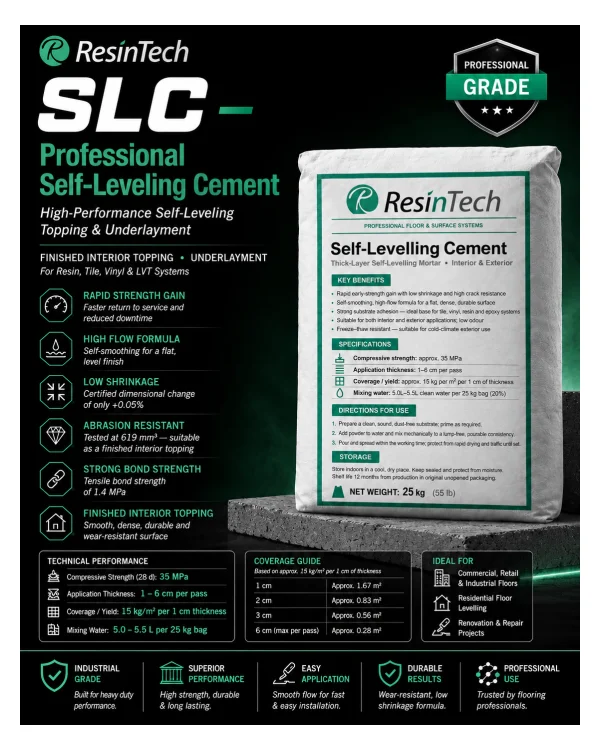
What SLC is
SLC is poured in place at 3–60 mm per pass and cures to a hard, seamless walk-on floor. Its abrasion resistance was verified by an independent ISO/IEC 17025-accredited laboratory (619 mm³ against a ≤ 800 mm³ limit), which supports its use as a finished interior wear surface, not only as an underlayment.
As a finished topping the cured surface is sealed with a compatible sealer or clear topcoat once it has reached an acceptable moisture content. As an underlayment it is overcoated with the specified flooring system.
Values are the manufacturer’s declared specifications determined to JC/T 985-2017; the ASTM methods shown are North American equivalents for comparison only. Where a specification requires ASTM-tested results, request ASTM testing from the manufacturer.
Packaging
| Component | Size |
|---|---|
| Dry powder | 25 kg (55 lb) multi-wall paper bag |
Mix ratio: 5.0–5.5 L clean potable water per 25 kg bag (≈ 20–22 %)
Supported applications
- Finished interior self-levelling floor topping / seamless wear surface (sealed)
- Smooth, walk-on floors for commercial, retail and residential interiors
- Renovation and resurfacing over sound existing interior floors
- Industrial and warehouse floor toppings (seal or topcoat to suit the traffic)
- Thick-layer underlayment beneath epoxy, polyaspartic, resin, tile and vinyl systems
Role in ResinTech systems: Levelling topping or underlayment beneath resin flooring; not a traffic-system material. See the traffic coating systems.
Product data
| Property | Typical value |
|---|---|
| Product type | Cementitious self-levelling floor mortar (JC/T 985-2017) |
| Application thickness | 3–60 mm per pass |
| Coverage / yield | ≈ 1.7 kg/m² per 1 mm of thickness |
| Mixing water | 5.0–5.5 L per 25 kg bag |
| Application temperature | 5–35 °C; substrate moisture < 4 % |
| Time to light foot traffic | ≈ 2 h at 20 °C |
| Ready for floor coverings / tiling | ≈ 24 h |
| Final strength (full cure) | ≈ 7 days |
| Shelf life | 12 months from production, unopened; store indoors, cool and dry |
| Origin | Manufactured for ResinTech |
Performance properties
Typical values at 23 °C and 50 % RH unless noted, as published in SLC TDS v1.0. Not a guarantee of performance.
| Property | Typical value | Method / note |
|---|---|---|
| Initial flow | ≥ 130 mm | JC/T 985-2017 (equiv. ASTM C1708) |
| Flow after 20 minutes | ≥ 130 mm | JC/T 985-2017 (equiv. ASTM C1708) |
| Drying shrinkage | ≤ 0.05 % | JC/T 985-2017 (equiv. ASTM C157) |
| Bond strength (tensile adhesion) | ≥ 2.0 MPa | JC/T 985-2017 (equiv. ASTM C1583) |
| Compressive strength, 24 h | ≥ 8.0 MPa | JC/T 985-2017 (equiv. ASTM C109) |
| Flexural strength, 24 h | ≥ 4.0 MPa | JC/T 985-2017 (equiv. ASTM C348) |
| Compressive strength, 28 d | ≥ 35.0 MPa | JC/T 985-2017 (equiv. ASTM C109) |
| Flexural strength, 28 d | ≥ 8.0 MPa | JC/T 985-2017 (equiv. ASTM C348) |
| Abrasion resistance | 619 mm³ (limit ≤ 800 mm³) | JC/T 985-2017 (equiv. ASTM C779); independently verified |
Coverage and film build
| Use | Film build | Typical coverage |
|---|---|---|
| 3 mm | per 25 kg bag | ≈ 4.9 m² |
| 5 mm | per 25 kg bag | ≈ 2.9 m² |
| 10 mm | per 25 kg bag | ≈ 1.5 m² |
| 30 mm | per 25 kg bag | ≈ 0.49 m² |
| 60 mm (maximum per pass) | per 25 kg bag | ≈ 0.25 m² |
Based on ≈ 1.7 kg/m² per 1 mm. Actual coverage varies with substrate profile, condition and application method.
Application conditions
| Condition | Requirement |
|---|---|
| Substrate | Clean, structurally sound, free of oil, grease, dust, laitance, curing compounds and loose material; mechanically prepared (grinding or shot-blasting) |
| Moisture | Check substrate moisture and confirm an acceptable moisture vapour emission rate before application |
| Priming | May be required depending on porosity; prime highly porous or absorbent substrates |
| Mixing | Low-speed drill and paddle, 2–3 minutes, to a smooth, lump-free, pourable consistency; do not over-water |
| Placing | Gauge rake or pin screed; spiked roller to release air; multiple passes above 60 mm |
Limitations
- For exposed topping use, seal with a compatible sealer or topcoat; for heavy industrial or vehicular traffic, use a flooring / topcoat system rather than leaving SLC bare.
- Do not apply over substrates with active water ingress or rising damp.
- Do not apply outside the recommended ambient / substrate temperature range.
- Do not over-water the mix — strength loss and increased shrinkage result.
- Interior use as tested; confirm exterior / freeze-thaw suitability with the manufacturer.
- Contains Portland cement and crystalline silica — see the SDS for handling requirements.
Technical documents
- ResinTech SLC — Technical Data SheetTDS · SLC TDS v1.0 · Version 1.0, issued 28 June 2026 · Dry powder · 4 pages · PDF
- ResinTech SLC — Safety Data Sheet (WHMIS 2015)SDS · SLC SDS v1.0 · Version 1.0, issued 28 June 2026 · Dry powder · 5 pages · PDF
Documents are the current versions published by ResinTech at the time this page was last built. Safety Data Sheets cover both components where the product is two-part.
Related products
Questions and answers
Can SLC be left as the finished floor?
Yes, indoors, once sealed with a compatible sealer or clear topcoat. Its abrasion resistance (619 mm³ against a ≤ 800 mm³ limit) was independently verified for use as a wear surface.
What is the maximum thickness per pass?
60 mm. For greater depths, apply in multiple passes and confirm minimum re-coat times between layers.
How much water per bag?
5.0–5.5 L of clean potable water per 25 kg bag (about 20–22 % by weight). Over-watering reduces strength and increases shrinkage.
Are the test values ASTM results?
No. Values were determined to JC/T 985-2017; the ASTM methods are shown as equivalents for comparison only. Request ASTM testing from the manufacturer where a specification requires it.